
OnwardsOS
The AI operations system I built to run Onwards itself — in production daily, refined weekly, and the clearest proof of what I sell.
How it started
My AI expertise doesn't come from reading about the tools. It comes from running my own business on them. Every technique I recommend to a client is something I've already built, broken and rebuilt for myself.
OnwardsOS is where that happens. It's the AI operations system behind Onwards: an agent wired into my knowledge base, calendar, invoicing and client ad accounts, with a command centre around it. It has run the business daily for months, and it has never been "finished" — every week of real use surfaces something to sharpen, and the system gets better at its job.
That loop is the point. Clients get the version of every idea that has already survived contact with a real business: mine.
A deeper view of Meta than Ads Manager gives you
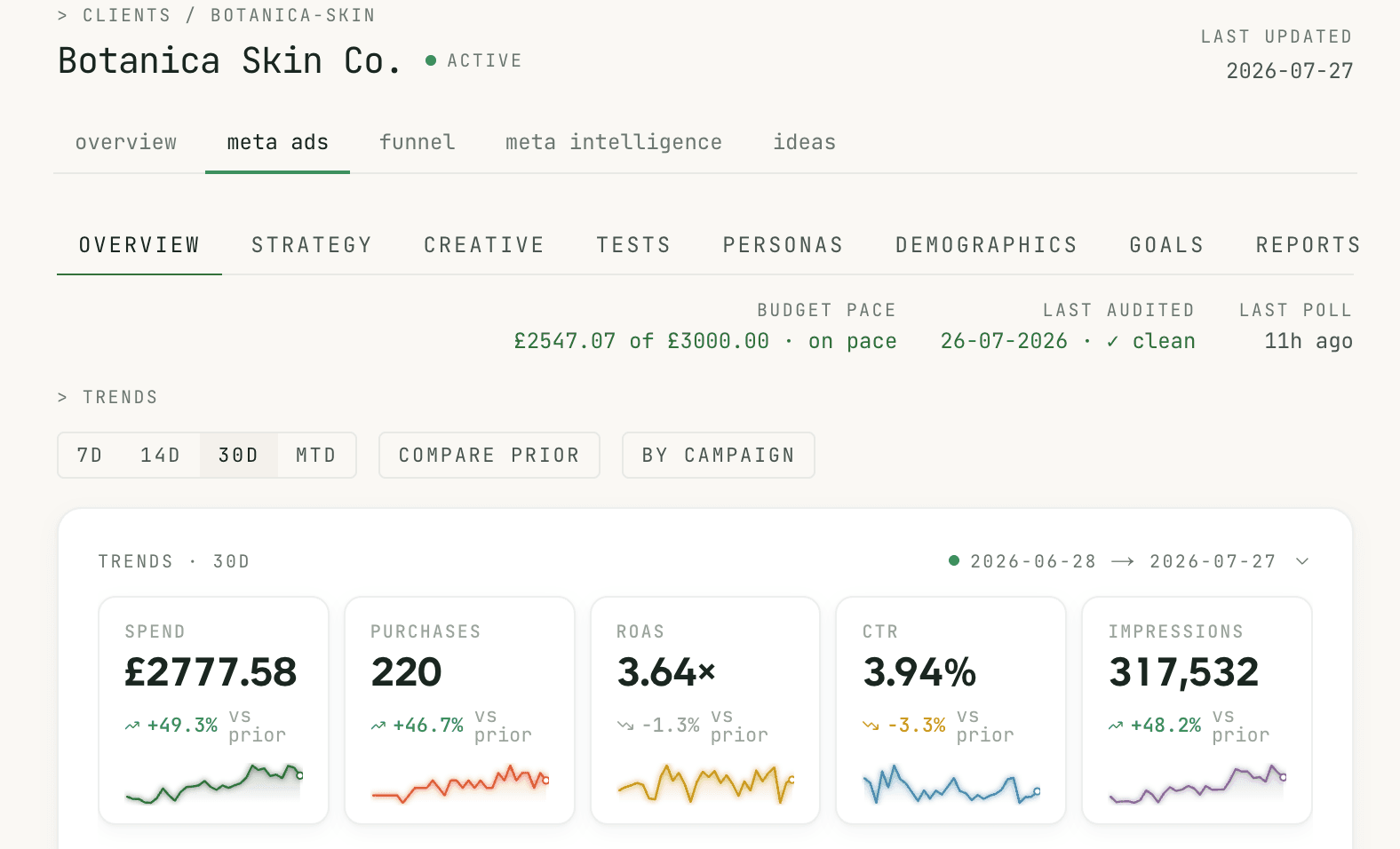
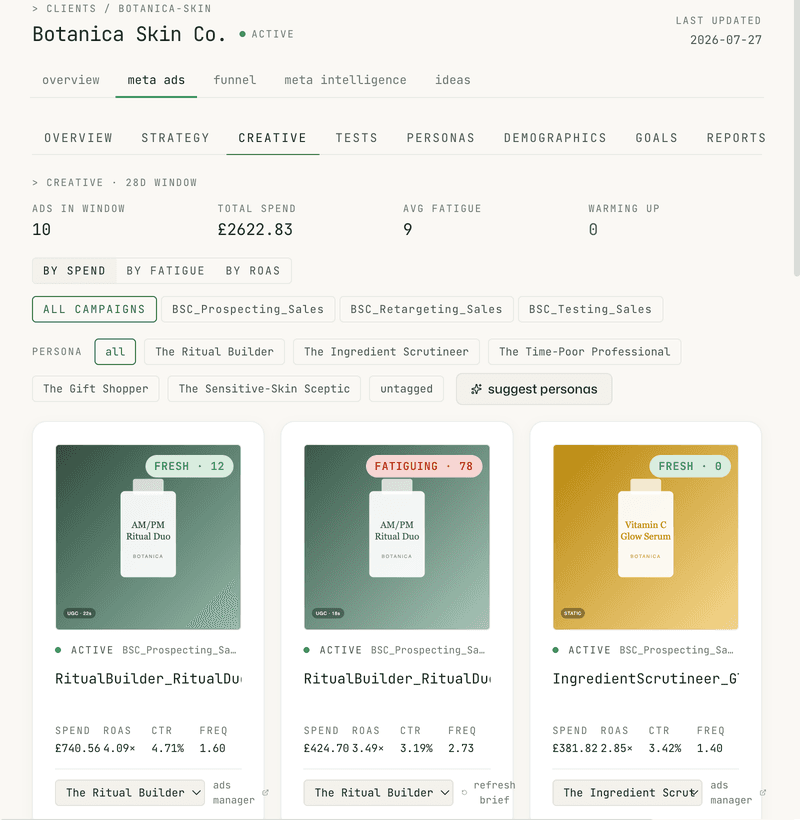
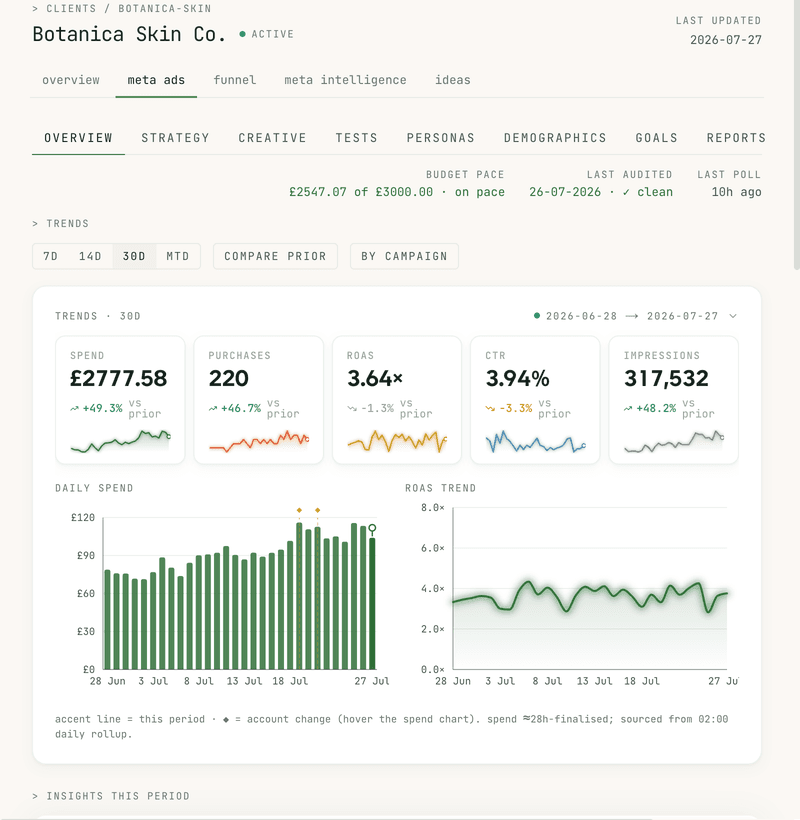
Meta's own reporting tells you what happened. It's much worse at telling you what to do about it. So I built my own analytics layer on top of the Meta API: every ad scored for creative fatigue before performance drops, every creative tagged to the customer persona it targets, budget pacing tracked against plan, and trends compared across any window.
That depth is what turns reporting into strategy. When I recommend moving budget or refreshing a creative, it comes from a system that sees more than the native platform shows, and the client gets the insight in plain language, not a CSV.
The screenshots on this page show the demo workspace with a fictional skincare brand, because the real dashboards are full of confidential client data. Everything else is exactly what I use every day.
An intelligence layer that finds proven winners
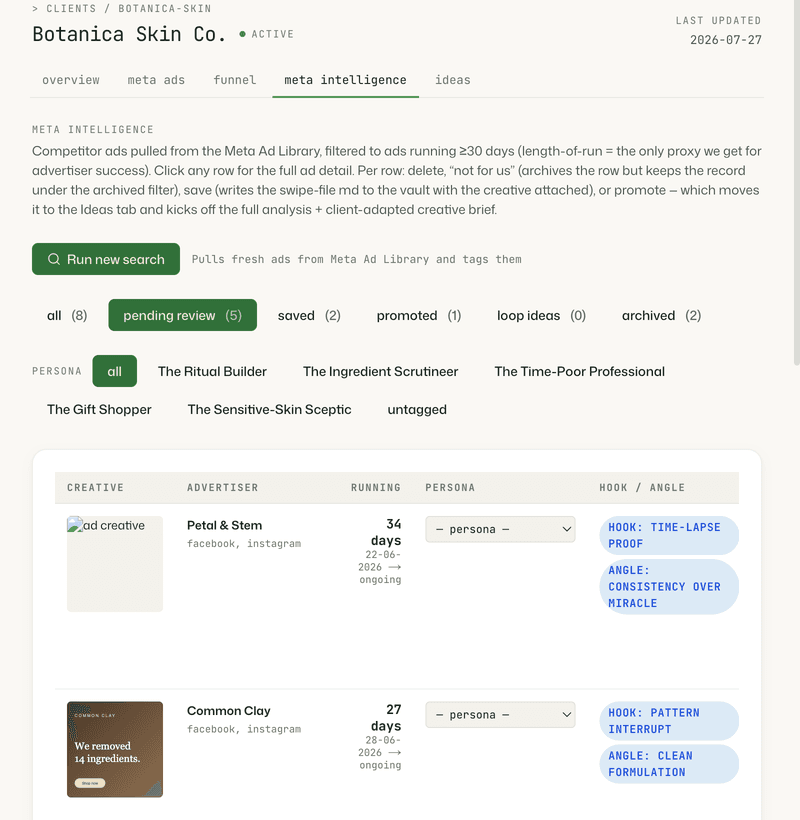
The same system watches each client's market, not just their account. It sweeps the Meta Ad Library for competitor ads and filters to the ones that have run long enough to be clearly working — the closest thing to a proof signal the Ad Library gives you.
When something is worth stealing well, one click runs a full creative analysis and writes a production-ready brief adapted to the client's brand, personas and current ad performance. Creative ideas arrive graded and grounded in evidence, not pulled from a swipe file.
Issues surface in hours, not days
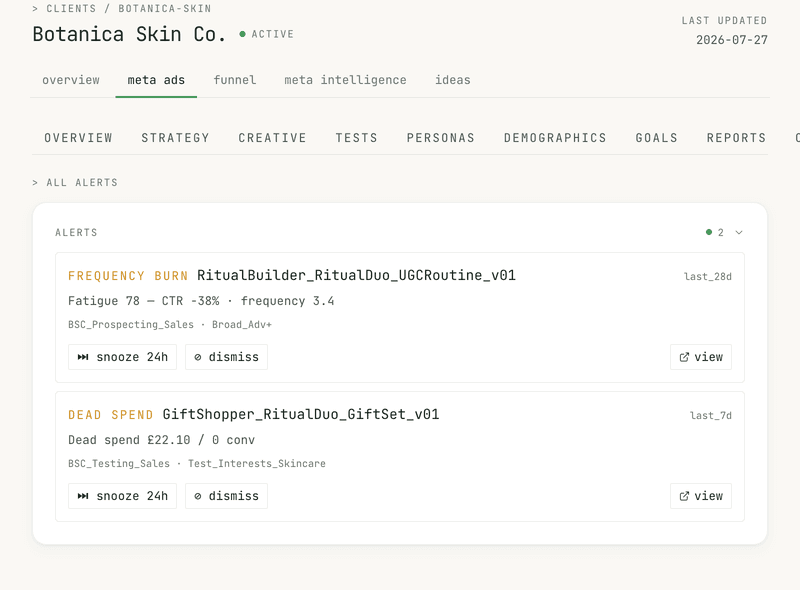
The monitoring runs around the clock. Fatigue scoring flags a creative before its performance falls off a cliff, dead spend gets caught while it's still small, and every anomaly lands as an alert with the context to act on it.
It isn't limited to ad accounts either. The websites I look after are watched the same way — uptime, page speed and security — so a site going down or slowing to a crawl gets flagged just as fast as a fatiguing ad.
For clients, that's the difference between a course-correction and a post-mortem. Problems that used to hide inside a monthly report get dealt with the week they appear — often the day.
The monitoring has proved itself in stranger ways too. A routine sweep once flagged that an API token had silently expired a week earlier — no error anywhere, just silence. The system noticed the silence. That's what infrastructure is for.
The same system runs the rest of the business
Around the ads sits the whole operation. The assistant has retrieval over my knowledge base, so questions about a client are answered from meeting notes, strategy docs and campaign history. Every week it writes a full Meta Ads strategy review per ad account before the week starts. Client status docs refresh after calls, invoices flow from draft to my accounting system, and every AI cost is attributed to the client it served.
Each of those started as a manual routine I did myself, then got systematised once I'd proven the shape of it. That's the build philosophy clients hire me for, applied to my own business first.
Held to a measured standard
"AI-powered" is easy to claim and hard to prove, so OnwardsOS is tested like software, because it is software. Its AI classifiers are scored against a 396-sample ground-truth corpus built from real production data. When one of them underperformed, the eval suite measured the fix: accuracy went from 43% to 84%, and no change ships if the score regresses.
Around the AI sits roughly 870 automated tests, and the whole system went through an adversarial security audit whose findings were all remediated. This is the difference between wiring a chatbot to a spreadsheet and building operations infrastructure you can trust a business to.
Tools used
Want a strategy like this?
Book a Free Call
Want results like these?
Book a free 30-minute strategy call. No obligation, no pitch deck.